Scroll through any yoga feed and you could be forgiven for thinking you need a matching outfit, a cupboard of props and a dedicated room before you can touch your toes. You don’t. Most beginners need far less than they think, and starting with less is often the kinder way to begin.
Here is the honest list: what is genuinely helpful, what is nice to have later, and what you can improvise from things already in your home.
The one thing worth having: a surface that grips
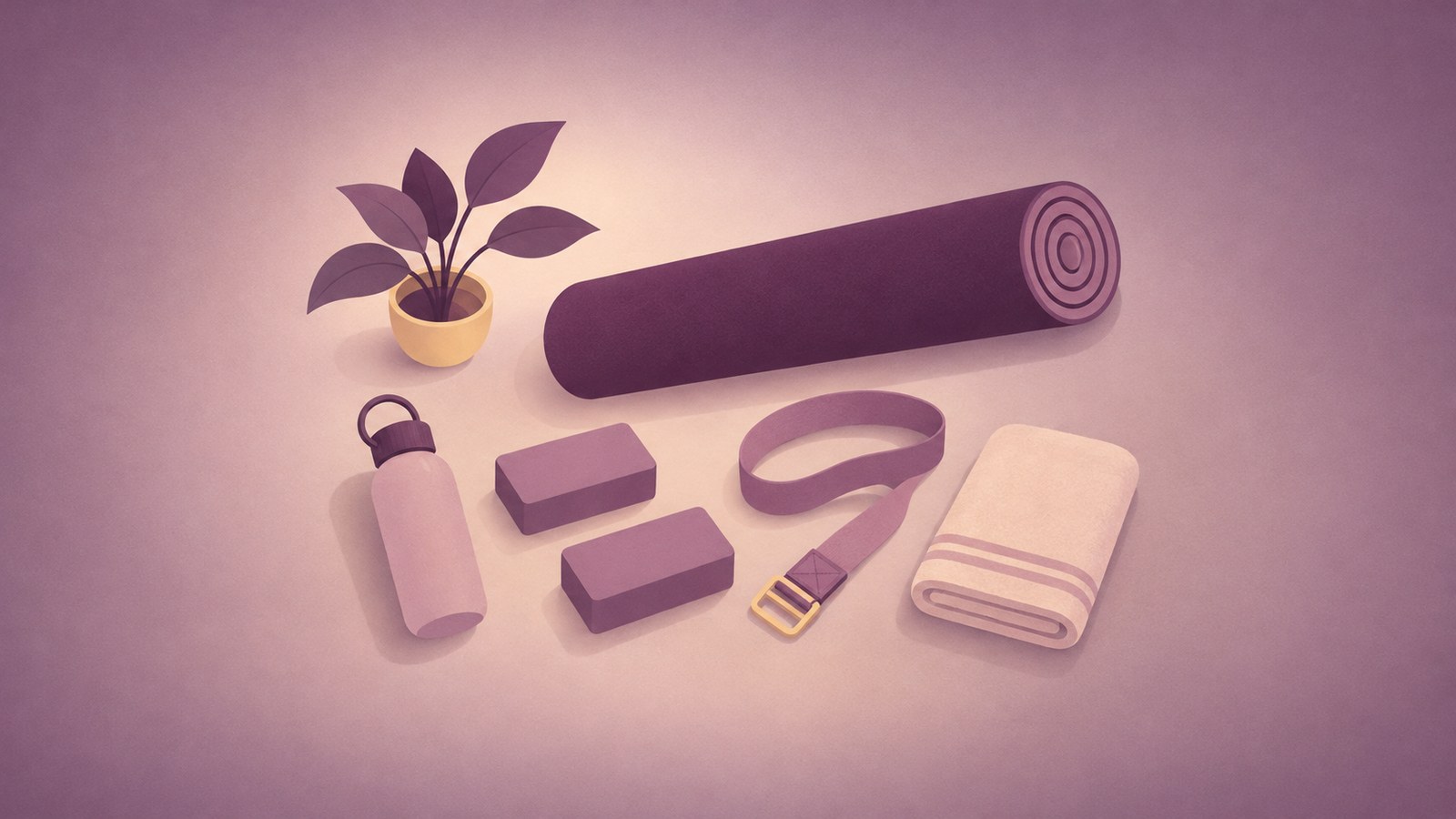
If you buy only one item, make it a yoga mat. The reason is simple: a mat gives your hands and feet something that doesn’t slide. Feeling steady makes you relax, and relaxing is half of what yoga is about.
When you choose one, think about three small things:
- Thickness: a medium thickness cushions your knees without making you wobble in standing poses.
- Grip: press your palm into it. If it feels tacky rather than slippery, that’s a good sign.
- Length: you should be able to lie down fully without your head or feet touching the floor.
No mat yet? A non-slip rug or a carpeted floor works for gentle, seated and lying-down movements while you decide.
Props that make poses easier, not “easier than you deserve”
Props have a slightly unfair reputation as something for people who “can’t do it.” In my classes I often say the opposite: props are how you make a pose fit your body, instead of forcing your body to fit the pose.
Two are worth considering once you’ve done a few sessions:
- Blocks: they bring the floor closer when your hands don’t reach it, and they can support you under your hips when sitting cross-legged.
- A strap: it extends your arms so you can hold a foot or stay comfortably in a stretch without rounding your back.
You don’t have to buy these on day one. Wait until you notice a moment in practice where you think, “I wish I were a bit closer to the floor.” That’s your cue.
What you already own
Your home is full of decent substitutes. Try these:
- A firm cushion or a folded blanket under your hips for seated poses.
- A thick, sturdy book or two in place of a block (wrap them in a towel so the edges feel softer).
- A belt, dressing-gown tie or long scarf instead of a strap.
- A bath towel, folded, for kneeling comfort or rolled under your ankles.
- A wall, which is a wonderful, free prop for balance and for feeling supported.
A small thing worth saying: if a substitute wobbles or slips, skip it. Stable and boring beats creative and risky.
Clothing: comfort is the whole rule
Wear something you can bend, reach and breathe in. That might be leggings and a T-shirt, or soft joggers and an old jumper. Skip anything that digs in at the waist or rides up when you fold forward. Bare feet are usually best for grip, but socks with grippy soles are fine if your floor is cold.
The things people forget
These cost nothing and matter more than any gadget:
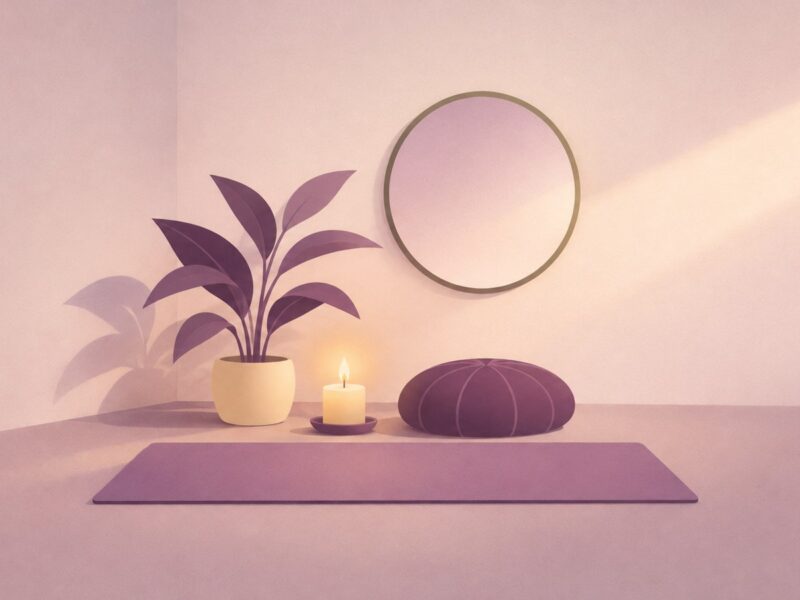
- Space: roughly the size of your mat plus an arm’s reach on each side. Move the coffee table if you need to.
- A little quiet: silence your phone, or at least put it face down.
- Water nearby: a few sips afterwards is usually plenty.
- A set time: even ten minutes at the same time each day teaches your body that this is a thing now.
- Permission to be a beginner: truly the most useful item on the list.
Start with the mat you have, the space you have and the ten minutes you have. You can always add more later.
A first session to try today
Once you’ve cleared a bit of floor, try this gentle ten-minute sequence:
- Sit comfortably and take five slow breaths (1 minute).
- Roll your shoulders back and forth, then tilt your ear gently towards each shoulder (1 minute).
- Come onto hands and knees and move slowly between arching and rounding your back (2 minutes).
- Press back into a resting pose with your hips towards your heels, arms long or by your sides (2 minutes).
- Lie on your back, hug your knees in, and rock gently side to side (2 minutes).
- Rest flat on your back with your arms relaxed (2 minutes).
If something hurts, stop and check in with a professional. Discomfort from unfamiliar stretching is one thing; sharp or lingering pain is another.
Spend later, not first
After a few weeks you’ll know what you actually want: perhaps a thicker mat, a bolster for resting poses, or a blanket you love. Buying after you’ve practised means every purchase solves a real problem rather than an imagined one.
And if you’d like company while you find your feet, you’re welcome to join us. Check the weekly schedule and come along in whatever comfy clothes you have on. Bring nothing but yourself.